
After installing pavers for homeowners across Ocoee, Winter Garden, Apopka, and Windermere, we hear the same questions at every estimate. This guide gives you the straight answers most contractor websites avoid — no upselling, no vague responses, just what you actually need to know before deciding on pavers and who to hire.
1. How Long Do Pavers Last in Florida?
Properly installed concrete or brick pavers in Florida last 30–50 years. Travertine and natural stone can last 50–75 years or longer. The critical word is "properly installed" — the base preparation determines everything. A 6–8 inch compacted aggregate base for driveways, or 4–6 inches for patios, gives pavers the stable foundation they need to flex with Florida's soil movement without sinking or shifting.
Contractors who use only 2–3 inches of base to save money produce driveways that start shifting within 3–5 years. With proper base and sealing every 3–5 years, your paver driveway or patio will almost certainly outlast the concrete it replaced.
2. Do Pavers Get Too Hot in Florida?
Yes — dark concrete and brick pavers in direct Florida sun can get quite warm. This matters most for pool decks where you walk barefoot. Travertine pavers stay the coolest of any material — that's the main reason they dominate Florida pool deck installations. Light-colored pavers in any material are significantly cooler than dark ones. For driveways and patios where you're always wearing shoes, heat is rarely a practical concern.
3. How Often Do Pavers Need Sealing in Florida?
Every 3–5 years is the standard for Central Florida. Florida's UV intensity fades paver color faster than in northern states, and high humidity promotes mold and algae growth in joints. Sealing does four things: protects color from UV fading, locks polymeric joint sand in place (preventing weeds and ant mounds), creates a stain-resistant surface, and enhances appearance. We apply the first coat at installation — after that, plan on resealing every 3–5 years.
4. Can You Install Pavers Over Existing Concrete?
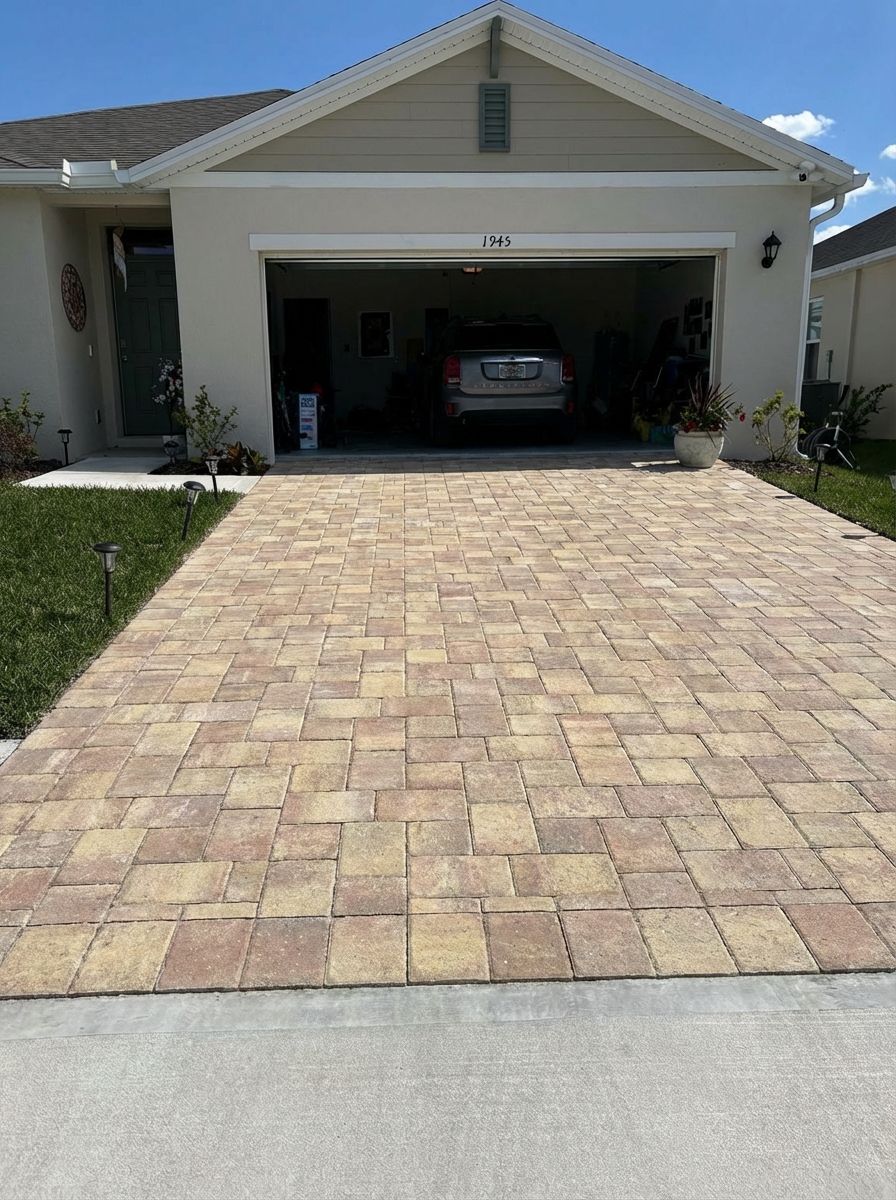
Technically yes — but for driveways we generally recommend against it. Overlaying pavers on existing concrete raises the surface height by 2–4 inches, causing problems with garage door clearance, landscaping borders, and drainage slopes. For patios and walkways, overlaying over a solid, level concrete slab is more viable and avoids demolition cost. We assess each situation during the free estimate.
5. Why Do Pavers Sink or Shift After Installation?
Almost always: inadequate base preparation. Florida's sandy soil shifts with moisture. When it rains heavily — every afternoon in summer — water infiltrates the base. A shallow or improperly compacted base moves, and the pavers move with it. The fix requires 8–10 inches of total excavation depth for driveways, 6–8 inches of compacted limerock base installed in layers, and proper plate-compaction between layers. Ask any contractor you're considering: how deep will you excavate and how many inches of base? Vague answers are red flags.
6. What Is the Best Paver Pattern for Florida Driveways?
Herringbone at 45° or 90° is the strongest structural pattern for driveways. The interlocking angle distributes vehicle weight across multiple pavers rather than concentrating it on single joint lines. Running bond is also solid and slightly less expensive. Avoid large-format pavers over 12 inches for driveways — they flex too much under repeated vehicle weight and crack. Save the large-format pavers for patios and pool decks.
7. Pavers vs. Concrete — Which Is Right for My Home?
Choose concrete if: budget is your primary concern, you need the project done fast, or you want a simple utilitarian surface. Concrete runs $4–$8 per sq ft versus $8–$22 for pavers. A well-installed concrete driveway lasts 25–35 years in Florida.
Choose pavers if: curb appeal matters, you're in a neighborhood where pavers are the standard (Windermere, Stoneybrook West, Arden Park), you want design flexibility, or you're thinking long-term. Pavers cost more upfront but last longer, repair cheaper, and boost home value significantly.
8. Do HOAs in Ocoee and Winter Garden Require Specific Pavers?
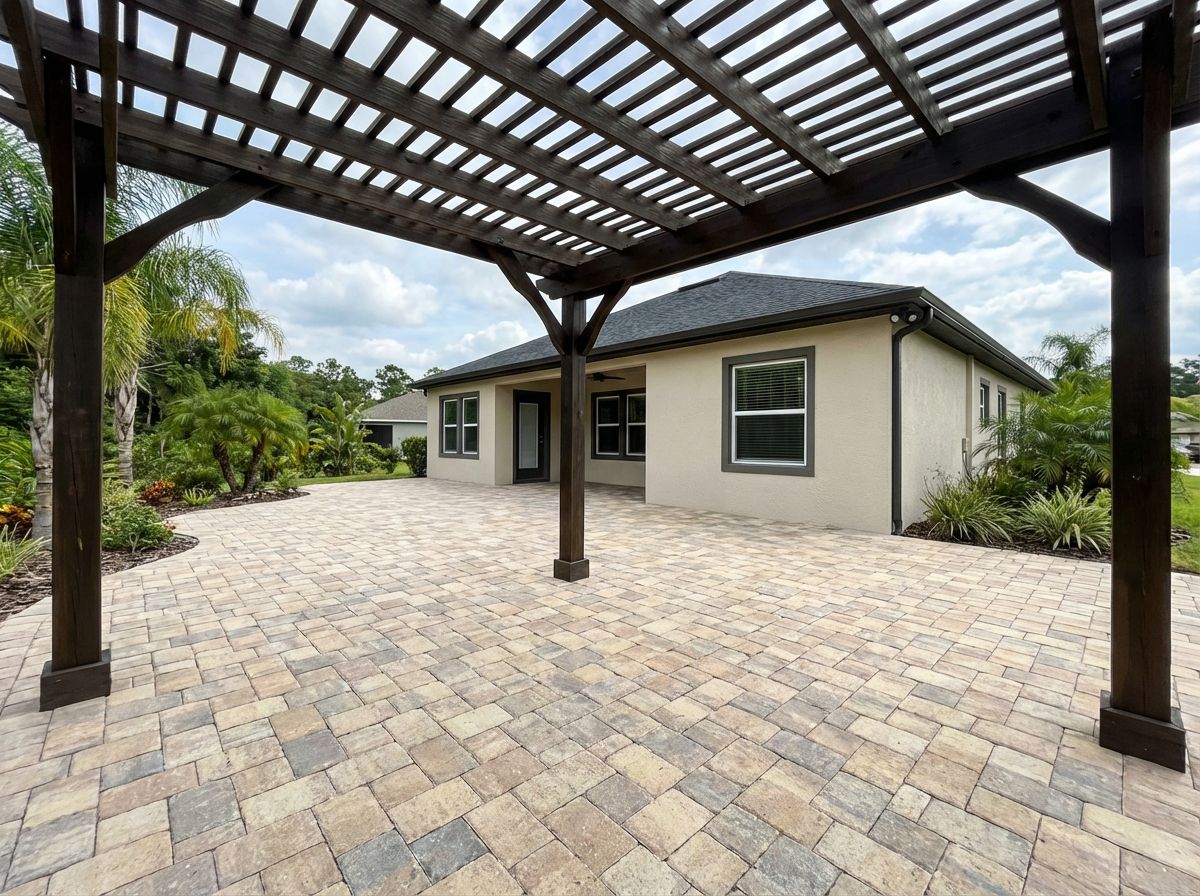
Many do. HOA requirements in Central Florida typically cover: approved paver colors (usually earth tones), minimum paver thickness (2.375" for driveways), border/edge treatments, and a pre-approval requirement before installation starts. Communities we regularly work in with specific HOA standards include Stoneybrook West, Independence, Waterleigh, Westyn Bay, Arden Park, and Keene's Pointe. We know these requirements and can advise on compliant options before you order anything.
9. How Long Does Paver Installation Take?
- Two-car paver driveway: 1–2 days
- Large or circular driveway (700+ sq ft): 2–3 days
- Standard patio (200–400 sq ft): 1 day
- Pool deck pavers: 2–4 days depending on size
Unlike concrete, paver surfaces are usable immediately after installation — no cure time. You can drive on your new paver driveway the same day it's completed.
10. What Is Polymeric Sand and Why Does It Matter?
Polymeric sand is the jointing material swept into gaps between pavers during installation. Unlike regular sand, it contains binding agents that activate when wet — creating a firm joint that resists washing out, weed growth, and ants. Regular sand washes out in Florida's heavy rains within 1–2 seasons. Properly installed polymeric sand lasts 10+ years. Always ask if a contractor uses polymeric sand. If they use regular sand to save money, your paver surface will deteriorate much faster.
11. How Do I Clean Pavers in Florida?
- Regular sweeping — removes debris before it stains, especially under trees
- Garden hose rinse — for light dirt, weekly as needed
- Pressure washing — 1–2 times per year, under 2,500 PSI with a fan tip (not pinpoint — it dislodges joint sand)
- Dish soap + stiff brush — effective for most surface stains
- Degreaser — for oil stains, apply immediately while fresh, let sit 15–20 min, scrub and rinse
Avoid bleach directly on pavers — it fades color and degrades the sealer. For algae in shaded patios, use a paver-specific cleaner with mildewcide before resealing.
12. How Do I Choose a Reliable Paver Contractor in Central Florida?
- Verify Florida license — ask for the license number and check on the DBPR website
- Insurance — both general liability AND workers' compensation. Without workers' comp, you're liable if a worker is injured at your property
- Written estimates only — verbal quotes are unenforceable
- Google reviews — look for volume (50+ reviews) and consistency, not just a high rating
- Ask about base depth — how deep they excavate and how many inches of base they install tells you everything about quality
- Written warranty — know exactly what's covered and for how long
Ocoee Concrete is a licensed and insured paver contractor based in Ocoee, FL 34761. We install paver driveways, patios, pool decks, and walkways for homeowners throughout Ocoee, Winter Garden, Apopka, Windermere, and surrounding Central Florida. 500+ projects completed. 4.9-star Google rating. Written estimates and workmanship warranty on every job. Call (689) 243-5726 Monday–Saturday, 7AM–8PM for a free on-site estimate.
Frequently Asked Questions
Ready for a Free Paver Estimate?
Licensed & insured. Written quote. On-site visit. Ocoee, Winter Garden, Apopka, Windermere & all of Central Florida.
Related: Paver Driveways · Paver Patios · Paver Cost Guide · Concrete vs Pavers